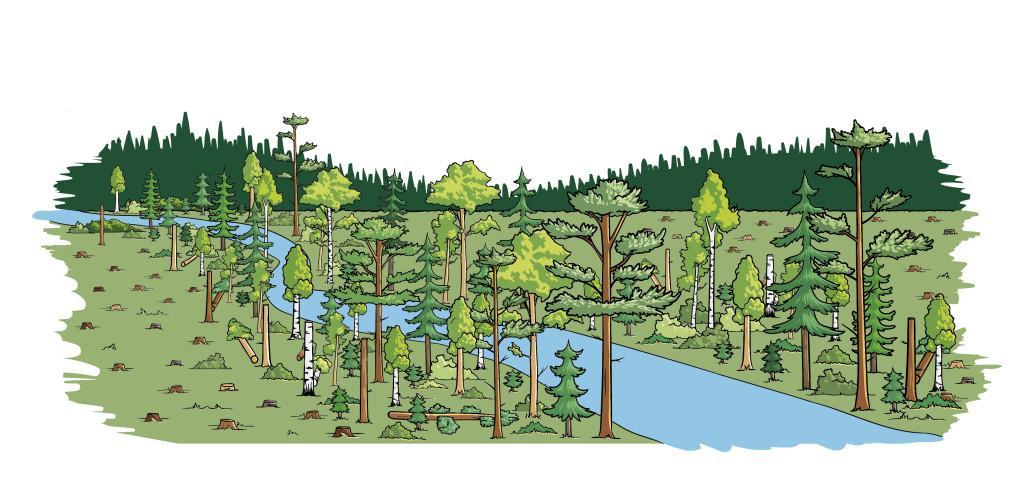
The origin of the wood used by Koskisen is known from the forest to the factory and all the way to the customer. Most of the wood comes from privately owned Finnish forests, and Koskisen holds the harvesting rights. Before any wood is harvested from a logging site, the site and its surroundings are checked for, among other things, protected areas, valuable habitats, waterway buffer zones and archaeological sites. Some of the checks are carried out using map data and, where necessary, some are conducted in the field.
“Koskisen’s responsibility in the forest is not limited to selecting contractors but extends to the entire harvesting operation: inspecting the site, providing instructions to contractors, monitoring the outcome of the work and taking responsibility for it,” says Maria Nyström, ESG Manager.
Traceability is built throughout the entire supply chain
A forest use notification is submitted to the Finnish Forest Centre before each operation begins. The notification is one of the key measures for ensuring the legality of the wood. In addition, Koskisen’s wood procurement team carries out its own checks and uses map and geospatial data. As part of the wood procurement process, it is verified whether the forest belongs to a certification scheme.
The origin of other wood-based raw materials, such as impregnating paper, is also monitored. Suppliers’ certificates, which demonstrate that the relevant verification processes are in place, are checked before purchasing and annually thereafter.
Certification is also important when selling products, and customers often require certified products. The share of certified material is monitored throughout the production process to ensure that the claim made for a product corresponds to the amount of certified raw material used.
“Certification is not a separate additional step that is checked only once. The information affects what kinds of claims we can make about our products later on. That is why the information needs to be maintained throughout the entire supply chain,” says Marika Viitanen, ESG Controller.
When logs arrive at the sawmill or plywood mill, they cannot be tracked as individual logs all the way to the finished product. Large quantities of logs from several different procurement sites are processed every day. Traceability is therefore based on careful management of information relating to incoming batches.
The origin, legality and certification status of each incoming batch are recorded and verified before the batch enters production. This means, for example, that a claim concerning an FSC-certified product is based on the actual amount of certified material used, even though an individual piece of wood cannot be traced to the level of an individual finished product.
EUDR introduces new requirements
The EU Deforestation Regulation, or EUDR, introduces new requirements for demonstrating the origin of wood. Under the regulation, information such as the location, or geolocation, of the procurement site must be provided for the wood used, as well as evidence that the area has not been converted from forest to another type of land use in the manner covered by the regulation and required under the relevant agreements.
Finland’s forest legislation, official monitoring and high level of certification support compliance with the requirements. EUDR also requires separate due diligence statements to be submitted to the EU information system when placing the relevant wood products on the market, as well as the retention of this information so that it can be verified when necessary, for example by the authorities.
Tracking the origin of wood is a shared responsibility across the entire chain. Information flows from wood procurement through purchasing, transportation and production all the way to sales. This enables Koskisen to demonstrate the origin of its wood and the related information throughout the supply chain.